Thursday, 12 September 2013

Part 1 Stage 2

Developing your source material

Wherever we travel I always gravitate to the textiles and I've got some fabulous mementos to show for it.  It was inevitable that this part of my course was going to be based around my trip to India.

Unsurprisingly I've found that some designs appeal to me more than others.  The very floral ones I find over the top but some the highly stylised shapes of the individual flowers are lovely.


Page from a book of floral designs
Northern India late 18th C
(V&A)


Page from a book of floral designs
Northern India late 18th C
(V&A)


I really like the idea of a client choosing a custom piece from designs a pattern book.
Two particular images I like are taken from the above pages and are quite similar.  I like their fantastical shapes.


I took the first of these isolated images and cut out the mains shapes.


Deconstructed flower


I played with the shapes and tried unsuccessfully to get a repeat pattern out of just a couple of pieces.

I was happier using almost all of the shapes but try as I might I couldn't seem to make anything that didn't look like a flower.


Re positioning the pieces


Drawing around the shapes


I tore strips of tissue in typical Indian colours


I cut out the shapes and contained them within a circle


It was much easier to forget flowers once the colours were changed.  However, although I love the colours I don't really think much to the design.  Maybe the organic shapes just need to be floral.


I like the effects of the multi layered tissue


This really close up image looks beautiful.


This shows the layering beautifully


It looks very different depending on its' orientation.


The red planet


A tempest


A tornado


I've decided to do another tissue collage with the shapes I'm going to have a go at reconstructing the flower.  I followed the same process as previously and I'm delighted with what I've created.


On a white background (my table)

Mounted on yellow paper

It took me awhile to get to this point but it has been so worthwhile.  I've looked at the possibilities for a repeat pattern as well.  This first one looks checked even though my background was a white table.  


The next one was constructed when I'd mounted the collage on yellow paper.  


With some tweaking this could be a design for wrapping paper or even furnishing fabric.

I want to push this a bit and try it in fabric but I'm going to work with my close up as a starting point.


I did a fabric collage using just the same technique as before.  However, I decided to go for more restrained colours. I used a variety of fabrics including some lace curtaining, organza, satin and cotton all on a base of dusky pink silk and acrylic felt for stability.  I free machine stitched in a variety of ways to blend the edges where the fabrics butted up to one another.


I cut the shapes randomly as before


I had some slippage and it left gaps.

I had great trouble getting the Bondaweb to stick because the fabric was quite thick in places. With some difficulty I managed to turn it upside down and iron it from the back.  Consequently there was some slippage that left me with gaps that I decided to fill with free machine stitching.


The very first image


My final interpretation

These colours make such a difference to the feel of the work.  It's less fun, more sophisticated.  I welcome the chance to try machine embroidery and I'm getting better at it but there's a way to go.

V&A Pattern, 2009, Indian Florals.  V&A Publishing


Monday, 9 September 2013

Sketchbook work

Water on slate

Last week we put a layer of oil based sealer on the slate tiles on our porch.  After the shower today they looked simply beautiful.


Even when they're needing a coat of sealer they are lovely but this is something quite special.

Part 1 Stage 1 (b)

Indian cloth in context

It's hard to imagine but India has produced high quality, colour fast textiles since the third millennium BC.  The earliest textile find actually in India was at Mohenjo-daro on the Indus River.  It shows that woven, madder dyed cotton was made all those years ago.  The find is unusual because the Indian climate isn't good for the preservation of fabric.  The only reason this piece survives is because it was wrapped around metal and it helped to preserve it.

The find shows an in depth understanding of the processes of colour fixing and a stone relief found on the same archaeological site shows figures draped with patterned cloth.  On the same site spindles were found and bronze needles which indicates that woven cloth was stitched and embellished. Development of this nature puts Indian textiles millenia ahead of anything that was happening in Europe. (Gillow and Barnard, 2008)

Strangely, much of our information about the development of Indian textiles doesn't come from India but from Egypt where quantities of trade cloth were uncovered in the nineteenth century.  Some of these textiles dated to the fifteenth century.  There are seventh century BC references to an Indian textiles trade with Mesopotamia and there are old Hindu texts that talk in detail about textiles processes used in the manufacture of cotton, silk and linen.

By the sixth century BC Indian textiles were coveted by Mediterranean countries and the Indians got their silk from China.  The Roman empire became concerned , as did later cultures, about the drain on the exchequer - the Indians had lots to export but it had to be traded in bullion because they weren't very interested in European goods.  All this suggests a very worthwhile product that met the customers needs. Real business acumen.

As time went on particular patterns were developed for particular markets (V&A 2009)

Skirt or shoulder cloth for the Indonesian market
(V&A 2009)
The cloth above is from the Coronmandel coast and is block printed and dyed cotton .  It is late eighteenth century and has a fairly typical Indonesian feel to it.

Compare it to this fabric  also from the Coromandel coast and made in the 19th century for the Thai market. Very different.  

Made for the Thai market
(V&A 2009)


Along with spices, textiles were a very important export for India.

For many years the Portuguese had a stranglehold on European trade with Asia  but with the arrival of the Dutch that began to change.  First the Dutch set up a base in Jakarta and developed a trade network that included India.  It enabled them to barter locally and get the best possible deals all without the need to deplete the national reserves.

The British were late on the scene and made their base in India.  The East India Company was establish and the rest as they say is history.

The impact of Indian textiles on Europe became even more evident when the likes of William Morris unashamedly developed designs based on Indian textiles and made them affordable to the masses. Indian Diaper, Snakeshead, Little Chitz and Pomegranate (now called Fruit) all show that Morris was conscious of Indian design. (Parry, 1983)


Diaper - block printed wallpaper, 1868-70
(V&A 2009)

Fritillary block printed wallpaper 1885
(V&A 2009)

Now that I've immersed my self in Indian textiles I can see lots of Morris designs that give more than a nod to that country.

Paisley is a pattern that Scotland claimed for its own but has its origins in India.  It is a pattern that is now global and a glance at my windowsill shows me it's all over my tissue box.


Textiles and society
India is a huge country and until the Raj when trains became the transport mainstay of the country, communication between the regions was minimal.  Geographical areas developed their own skills and methods of textile production and so gave India a textile richness that is unequalled in the world. Even today the various ethnic groups pride themselves on their individual approach to their textile work. Referring to a visit to a bazaar some years ago Gillow and Barnard tell us that they saw

communities and castes living side by side, at peace - and expressing their differences through colour and textiles.


Indian textile map gives an idea of the diversity of the Indian textile industry. 
business.mapsofindia.com

Textiles have been and still are a social indicator in India.  Colour has been used to show not just a personal preference but also to send all sorts of messages about social standing including age, marital status and community of origin.  The hangover from India's historical caste system, whilst now outlawed, is still evident.  http://handeyemagazine.com/content/colour-and-encoded-meaning

The use of colour seems to be fairly consistent throughout the sub continent and became associated with social bandings between 2000BC - 600BC.

White became the preferred colour of the highest caste because it symbolised purity and light and this carried through to the use of white as the colour of a wedding sari in some areas.  Sounds familiar).
Throughout India men choose to wear off white and widows wear it unadorned with any other colour.

Red is seen as a lucky colour and so was chosen by those intending to go into battle.  It is the colour of fertility and many Indian brides choose to wear red.  A maroon shade with a gold border is traditional in Tamil Nadhu and red teamed with green (another colour of fertility) is chosen by Maharashtran brides.

Saffron yellow or orange is the colour of moderation and self discipline and was used to symbolise the withdrawal from family to lead a spiritual life.  In some communities it is seen as a lucky colour and used in wedding celebrations.

In past times blue was the colour associated with the lowest caste and it was thought to be contaminated and unlucky.

The climate also plays a role in how colour is used.  In hot, dry desert areas the colours tend to be vibrant whilst in high summer cooler colours might be selected.

And then of course there's always the exception to the rule.

http://handeyemagazine.com/content/colour-and-encoded-meaning
Gillow, J & Barnard, N 2008, Indian Textiles. Thames and Hudson, London
Parry, L. 1983, William Morris Textiles. Crescent Books, New York.
V&A, 2009, Indian Florals
V&A, 2009, William Morris

Sketchbook work

Ready for Home

We've just had a few days in North Yorkshire and taken some lovely photos.  This one really captured my imagination.  I wonder which of the swallows will make it across the miles?


Ready for home.

I used a sponge for the dappled sky, white paint splodges for the birds' body and tried for calligraphy type marks for the wings and tails.  I just wanted the feel of imminent departure and fragility.  I'm quite pleased with this.


Wednesday, 4 September 2013

Sketchbook work

Playing with paisley

I've seen so much paisley print is the last few days I was moved to look out my blocks.
My blocks


I selected the paisley design and the small round one 


and had a play.


Not amazing but fun and a really timely reminder that block printing takes some skill to get even pressure.


Tuesday, 3 September 2013

Part 1 Stage 1 (a)

Embroidery, quilting and printing.

In a few weeks I'll be travelling to Northern India so I've been looking at the textiles I can expect to see.

The task is huge because Rajasthan is a prolific producer of textiles of all kinds.  Each district has its' own particular take on themes of embroidery, quilting and printing.  Most of the everyday fabrics are cotton and "out of 862 spinning mills in India, 69 spinning mills are in Rajasthan"  http://rajasthantextiles.com/

Embroidery 
http://rajasthantextiles.com/ has been an invaluable source of information and highlighted just how much work goes on in Rajasthan.  It lists 19 different sorts of embroidery.  Principally they are decorated cloth; usually cotton but sometimes wool.  Some types like Mochi originated as a chain stitch decoration for leather but has been adapted for fabric.  A hooked awl is used as a "needle".


Mochi embroidery
 http://rajasthantextiles.com/


Sometimes the thread isn't quite what you might expect.  In Badla embroidery metal is melted and passed through perforated steel sheets to makes wires which are then hammered to the required gauge. Plain wire is called badla and when it is wound round a thread it is called kasav.  Smaller pieces are called mukaish.

Zari is also worked in metal and done by men who pass the skills on to their sons.  They guard its' secrets closely.  Zardozi is more elaborate and uses precious metal threads, beads and spangles.

Zari 
http://rajasthantextiles.com/


Dabka  is an extremely detailed type of embroidery which is very labour intensive.  Several people work on a piece at the same time because the work is very fine.  A cord is couched into the fabric in the required pattern with zari thread.  The images are usually taken from nature, flowers, birds and the like.


Dabka
 http://rajasthantextiles.com/


Salma (or nakshi) is considered a slightly inferior form of Dabka but it is much more glitzy and therefore essential to wedding outfits.  Beads and so on are attached by a variety of stitches. Applique motifs are integrated and done exclusively by men.


 Salmahttp://rajasthantextiles.com/


Sujani work comes from the east of Rajasthan and is used to make winter clothes for a climate that can be quite cold.  An old cloth is used as a lining (three or four thicknesses) and a new cloth laid over the top and decorated with chain and running stitch depicting the natural world.  This technique was used in earlier times for decorating leather for scabbards and pouches.


Sujani 
http://rajasthantextiles.com/


Sujani coat
 http://rajasthantextiles.com/


This is just a small selection of regional embroidery styles and themes.

Quilting
A razai (quilt) is usually made of cotton although the shell may sometimes be of velvet or silk.  The filling is of carded cotton and is the equivalent of our duvet fillings.  Carding allows all the impurities in the raw cotton to be discarded and pulls the cotton fibres until they are light and fluffy.  A worker starts with a kilo of raw cotton and ends up with only about 100 grams of material suitable for use in a Jaipuri razai.

The outer shell is often decorated with block printing before being assembled into a razai.  It is important that the cotton fibres are laid evenly so the warm air is trapped in the layers.

The filling is secured with hand quilting although the edges are usually stitched by machine nowadays.

rajasthanitextiles.com


A Rajasthani razai
www.quiltstudy.org

www.quiltstudy.org

Printed textiles
I will be visiting the Sanganer region of Jaipur which is famous for its textile industry.  The printing industry in the area developed when craftsmen from Gujarat settled probably towards the end of the 17th century.  Prior to that time textiles were produced but they were plain dyed.

There are probably about 500 block and screen printing units in Sanganer and 125 hand block printers.  Many of these are craftsmen working in there own homes.  The area has become renowned for the production of colourful dresses, bed linen, curtains and yardages of fabric.  Much of what is produced is exported.

If there is an industry of block printing someone has the make the blocks and dye the fabrics.  The dyers and block makers came from Sindh and Punjab and are mainly Muslim.

Block making is an extremely skilled occupation.  The block itself is made in several stages


  • the design is drawn on paper
  • it is then transferred to wood
  • the design is pierced through to leave an impression in the wood
  • the unwanted areas are carved out
  • the handle is attached to make the printing easier


The handle is very significant; it serves the same purpose as a signature and makes each block attributable to its' carver.

The outline blocks are made from an Indian teak called seesam because they need to be robust.  Softer wood is used for the blocks which infill the outline shapes.

Nowadays a printing table is 1.5 meters wide, 6 meters long and is about 1.2 meters high.  However, some older printers prefer the smaller, traditional tables.  The printing tables are covered with over 20 layers of hessian then 3 or 4 layers of old cloth.  These final layers are changed every time a new print is started.

The favoured Sanganeri prints are flower and petal designs.  Many of these designs, whilst based in nature, are of flora the craftsmen have never seen.


Traditional Sanganeri designs
resources.archedu.org

A Sanganeri print
www.india-travel.biz


A modern printing table
www.pbase.com


There are other printing techniques as well including mud resist (akola) and azrakh which is a reverse resist process.  There is also a lot of screen printing, hand, flatbed and rotary printing.  This demonstrates the increasing industrialisation of the process as demand has gone global.


Dyeing
Different types of tying and dyeing have been used in Rajasthan for over 5000 years. http://rajasthantextiles.com/  Ancient people discovered that extracts from plants could be used to colour fabric and it was used as an embellishment.  These dyes are still used today but increasingly man made dyes are used as well.

Indian craftsmen became very skilled at dyeing and their beautiful fabrics became a commodity for trade.

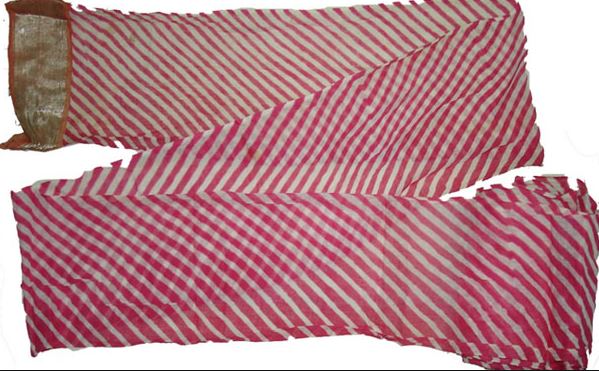
There are many designs that can be made using the tie dye technique.  The most famous one from Rajasthan is Leheria (in Hindi this means waves).  In the 19th and early 20th centuries the merchants of Rajasthan who were the dominant business community wore an elaborately tied and brightly coloured turban as a sort of uniform.. These turbans were decorated using the leheria tie dye technique.

The fabric needs to be quite fine like muslin, so the dye can penetrate the many layers.  The long, narrow cloth which can be used for a turban or a sari, is rolled on the diagonal then tied at the required intervals.  It is then immersed in dye and the result at its' most basic is a fabric with diagonal stripes.


Leheria
resources.archedu.org

The design can be further enhanced by untying and refolding from the opposite corner, tying once more and dyeing again.  This pattern is called mothara.  This name derives from the lentil shaped spaces that arise from this dyeing process, "moth" is lentil in Hindi.


Showing many dye repeats to make a complex pattern
Gillow and Sentance, 1999 p 127


The illustration above shows the way the fabric is tied.  When it goes to the retailer only a little of the fabric is unwrapped and the rest is left tied.  This shows the customer that the article is genuine.

I think this is the most beautiful way to dye cloth and I hope I can see it on my holiday.  If I do I'll not be able to resist buying some.  Maybe I'll have to try it myself.


Gillow J. and Sentance B. 1999, World Textiles, Thames and Hudson, London.
http://rajasthantextiles.com/


Sunday, 1 September 2013

Sketchbook work

Rubbings

My mother in law has recently moved into somewhere that can offer her more care so the contents of her flat have had to be disposed of.  I've done a few rubbings of items that might lead to some creative work.  I couldn't think of a better way to remember and move on.


Gran's chairback - well worn


The central motif didn't work well
But the leaves did


The chairback is curved so I don't think using the shapes as printing blocks will work but a collograph print might.

The next rubbings are taken from an Edwardian brass fingerplate.


Both images here are on photocopy paper.  For the one on the left  I used a 8B pencil and the other one is a wax crayon.  The following pictures show how different the flowers and the bird look close up.